
When people see photos of Dayalbagh’s lush fields, dairy, and tree‑lined roads, one question often follows: who actually runs all this? It is one thing to talk about ecotheology and community farming in theory; it is another to keep a whole settlement living that way, every single day, across generations.
In an earlier post, I wrote about how farming in Dayalbagh can feel like stepping into an open‑air temple, where soil, seed, and sweat become part of a daily act of worship.
In this post, I want to stay with that “who” and “how”: how a living spiritual centre, shared values, and a distinctive education system shape the way work, conflicts, and change are handled in Radhasoami Faith Dayalbagh.
A Living Centre: Sant Satguru and the Shared Vision
Dayalbagh is not simply an eco‑village that later added a religious identity; it is a faith‑based community that has grown its ecological and social practices around a spiritual centre. The overall direction of community life is shaped by the Radhasoami Satsang Sabha, the central body of the faith community, under the guidance of a living Sant Satguru.
At present, Revered Prof. P. S. Satsangi is the Sant Satguru of the Radhasoami (Ra Dha Sva Aa Mi) Faith. He also serves as Chairman of the Advisory Committee on Education (ACE), which guides the educational policy of Dayalbagh Educational Institute. This dual role is important: it means that spiritual guidance and educational vision are not two parallel tracks but deeply intertwined.
In Radhasoami (Ra Dha Sva Aa Mi) faith, understanding, bhakti (devotion) and prem (love) for the present and past Satgurus are not just private emotions; they are the inner source of discipline, commitment, and a willingness to work together for the common good. When people share the same spiritual focus, the “big picture” becomes more than a management chart—it becomes a lived aspiration.
Dayalbagh Educational Institute: Where Vision Meets Research and Training
Within Dayalbagh, the Dayalbagh Educational Institute (DEI) is a “deemed to be university” that functions as both an academic institution and a practical laboratory for the community’s way of life. Its education policy, originally framed in 1975, explicitly aims at “integral education” — spiritual, moral, intellectual, and vocational — rooted in the values of the Radhasoami (Ra Dha Sva Aa Mi) Faith and the everyday practices of Dayalbagh.
DEI’s programmes range from pre‑nursery to doctoral levels and cover fields such as agriculture, dairy technology, renewable energy, management, social sciences, and education, with a strong emphasis on skill development and social service. Many faculty members serve in honorary or partly honorary capacities, reflecting the ethic of seva (selfless service) rather than purely transactional employment.
In practical terms, DEI acts as the research and training “engine room” for Dayalbagh’s ecological projects:
- developing agroecological methods for the community’s Agroecology‑cum‑Precision Farm,
- studying water, soil, and air quality,
- designing nano‑enterprises in dairy and food processing,
- and taking these models to rural and tribal areas through outreach centres.
So while the Sant Satguru and RSS hold the spiritual and overall vision, DEI operationalizes it in education, research, and training.
From Vision to Daily Seva
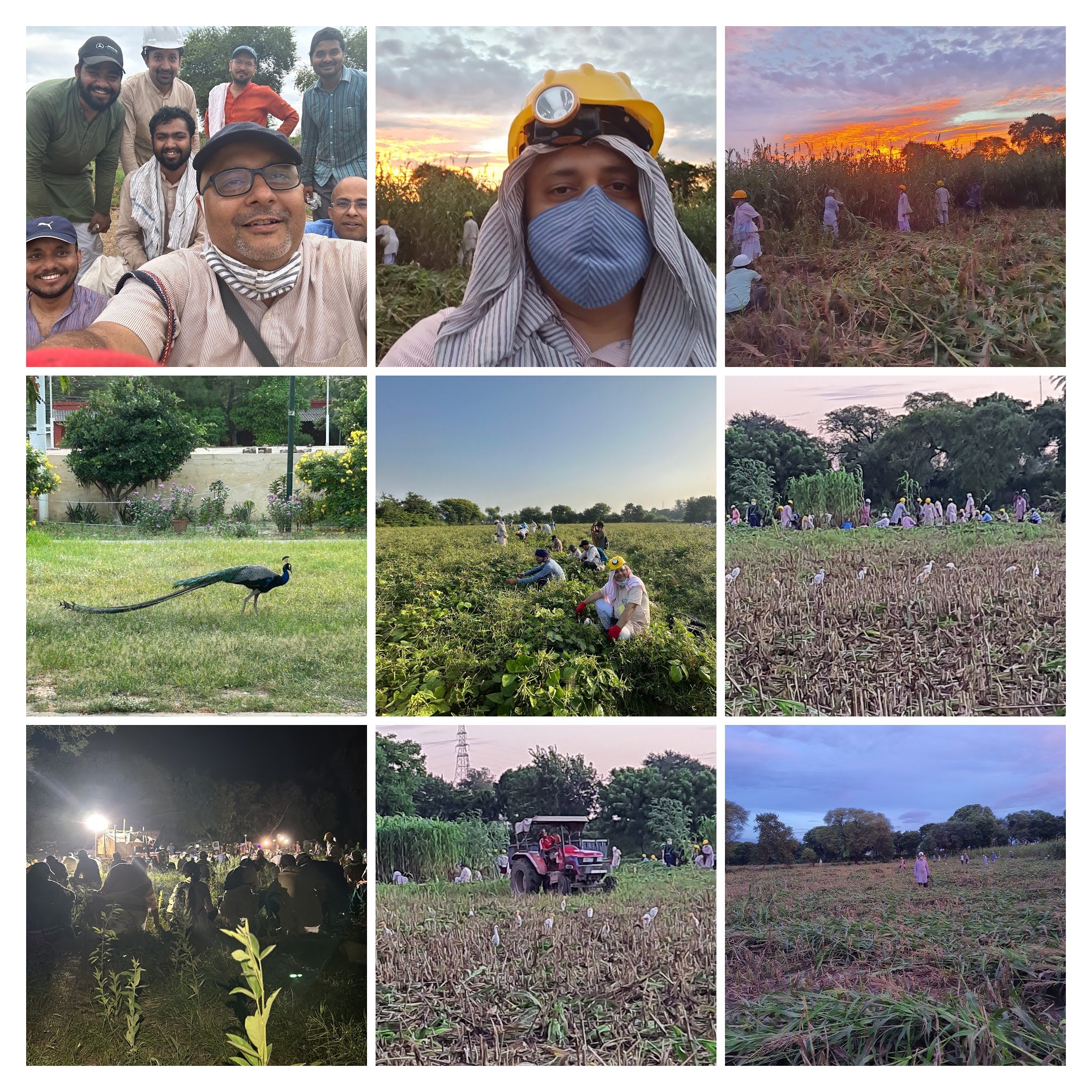
If you walk through Dayalbagh early in the morning, you will see that the vision is not only in policy papers; it is in the mud on people’s hands. Residents – young and old, men and women – go to the fields and Gaushala (Cowshed) in organized shifts, working voluntarily in ploughing, weeding, harvesting, fodder cutting, milking, composting, and related tasks.
In Dayalbagh, all volunteers below the age of seventy are affectionately referred to as “Young Men” and “Women,” and everyone is encouraged to offer seva within the limits of their physical capacity. The emphasis is not on how much one can do, but on participating joyfully in a shared act of service.
This is very much a “practice what you preach” culture. The present Sant Satguru himself, Revered Prof. P. S. Satsangi, continues to go to the agricultural fields to perform seva even at the age of eighty‑nine, setting a living example of humility and devotion for the entire community. In many ways, his quiet, steady fieldwork echoes the spirit of Srimadbhagavadgita (2.47) “कर्मण्येवाधिकारस्ते” — कर्मणि (in action), एव (only), अधिकारः (your rightful responsibility), ते (yours): a reminder that one’s place is in doing the work, not grasping at its results.
These daily rhythms are not enforced by salaries or fear of penalties. They are carried by shared values:
- seva (selfless service) as an expression of bhakti (devotion),
- dignity of labour,
- simplicity of lifestyle,
- and a commitment to the “Fatherhood of God and Brotherhood of Man,” which extends to care for land, water, animals, and neighbours.
Because people see tangible fruits – cleaner surroundings, affordable food, strong community bonds, and a sense of participation in something larger than themselves – the model continues to attract participation without constant persuasion campaigns.
A Values‑Driven Way of Handling Difficulty
From outside, we rarely get access to the internal details of how interpersonal conflicts are handled, and it would not be honest to speculate. What we can see clearly, though, is how Dayalbagh responds to practical challenges and potential “failures” in its ecological and social experiments.
Over the past decades, community members have:
- transformed once sandy, ravine‑ridden land into fertile, organically managed fields;
- addressed water scarcity by combining rainwater harvesting, treated wastewater reuse, and drip irrigation, reducing water use and production costs;
- introduced sensor‑based monitoring and cooling systems in the Gaushala to protect animals from heat stress;
- and responded to air pollution and the COVID‑19 pandemic by using open‑air spaces, restricting vehicles, and relying on biodiversity buffers and local food systems.
In each of these cases, the community did not simply endure problems; it experimented, adjusted, and learned. DEI’s education policy speaks of fostering “frugal innovation” and “learning by doing,” and the institute’s entrepreneurial labs and nano‑enterprises embody a culture where trying, failing, troubleshooting, and trying again are normal parts of growth.
Taken together, this suggests that Dayalbagh’s way of handling difficulty is less about hiding failure and more about treating it as a shared problem to be addressed in a spirit of seva and experiment. The system is deliberately values‑driven, experimental, and adaptive in the face of environmental and practical challenges.
From a spiritual perspective, the presence of a living Sant Satguru and the community’s prem (love and affection) for the Satgurus of the past and present provide the inner orientation needed to resolve problems when they arise.
Growing Up in the Middle of It: Children and Youth
What does all this look like for children and Gen Z? In Dayalbagh, young people are not only observers of the system; they are formed by it from the earliest years.
- Early childhood: Even very young children are exposed to field environments and values education in natural surroundings, through schemes that emphasize discipline, cooperation, and selfless service in age‑appropriate ways.
- School and college: At DEI, courses in agriculture, environmental studies, social service, and rural development are built into the curriculum. Students regularly participate in field seva, Yamuna river clean‑up efforts, and social‑service camps, often working alongside older community members and teachers.
- Higher education and skills: Programmes like B.Voc and M.Voc in Dairy Technology, Food Processing, Apparel, and Renewable Energy are tied to real units – mini dairy plants, garment workshops, and food‑processing labs – where students learn to run small enterprises in a value‑based way.
Special initiatives such as ATMA (Apparel and Toy Making Association), ADyNam (Agricultural and Dairy Nano‑processing of Multi‑products), and AAM (Automotive and Multi‑skill Karkhana) train youth and women in practical skills, both within Dayalbagh and in outreach locations like the tribal cluster of Rajaborari.
In this way, the younger generation does not have to be “convinced” of the model after the fact; they grow up inside it.
Beyond Dayalbagh: Sharing the Model
Though Dayalbagh has a strong internal identity, it is not inward‑looking. DEI and the community have taken their integrated model of faith, ecology, and education to other regions, especially rural and tribal areas.
In Rajaborari (Madhya Pradesh), for example, DEI and Dayalbagh have helped establish a “Forest of the Merciful” cluster of villages where education from pre‑nursery to higher levels is provided through ICT (Information Communication and Technology) centres and EDUSAT, and where local people are trained in skills such as garment making, food processing, and automotive services under initiatives like ATMA, ADyNam, and AAM.
Internationally, Dayalbagh’s approach has been showcased in policy forums (such as the G20/T20 process) as a community‑based path toward achieving the UN Sustainable Development Goals, and linked institutions like the International Centre for Agroecology (ICA) in New Jersey and the International Centre for Applied Systems and Sustainable Development (ICASSSD) in Toronto help carry its insights to other contexts.
Here too, the sharing is not only technical; it is ethical and spiritual. The insistence on honesty, simplicity, non‑violence, and service shapes how training is offered and how partnerships are conceived.
Organization as a Form of Bhakti
Seen from a distance, Dayalbagh’s organization can look very intricate: spiritual leadership, Radhasoami Satsang Sabha, DEI, agroecology, precision farming, nano‑enterprises, outreach centres. But looked at from within, there is a simpler thread holding it together: bhakti and prem for the Satguru, expressed through values‑driven work in every domain of life.
In that sense, the question “who sees the big picture?” has a layered answer. Yes, there are committees, frameworks, and institutional roles. But beneath them is a shared spiritual orientation that treats organizing, teaching, farming, and problem – solving themselves as forms of devotion.
For those of us looking in from outside, Dayalbagh offers not a ready‑made blueprint, but a living example: when spiritual guidance, ethical values, research, and daily labour are all allowed to pull in the same direction, it becomes possible – not easy, but possible – to sustain a community that cares for its land and its people over the long haul.