Ajitabh Pandey's Soul & Syntax

Exploring systems, souls, and stories – one post at a time

Category: Science, Philosophy and Religion

  • Who Holds the Plough and the Vision? Inside Dayalbagh’s Spiritual Ecology

    When people see photos of Dayalbagh’s lush fields, dairy, and tree‑lined roads, one question often follows: who actually runs all this? It is one thing to talk about ecotheology and community farming in theory; it is another to keep a whole settlement living that way, every single day, across generations.

    In an earlier post, I wrote about how farming in Dayalbagh can feel like stepping into an open‑air temple, where soil, seed, and sweat become part of a daily act of worship.

    In this post, I want to stay with that “who” and “how”: how a living spiritual centre, shared values, and a distinctive education system shape the way work, conflicts, and change are handled in Radhasoami Faith Dayalbagh.

    A Living Centre: Sant Satguru and the Shared Vision

    Dayalbagh is not simply an eco‑village that later added a religious identity; it is a faith‑based community that has grown its ecological and social practices around a spiritual centre. The overall direction of community life is shaped by the Radhasoami Satsang Sabha, the central body of the faith community, under the guidance of a living Sant Satguru.

    At present, Revered Prof. P. S. Satsangi is the Sant Satguru of the Radhasoami (Ra Dha Sva Aa Mi) Faith. He also serves as Chairman of the Advisory Committee on Education (ACE), which guides the educational policy of Dayalbagh Educational Institute. This dual role is important: it means that spiritual guidance and educational vision are not two parallel tracks but deeply intertwined.

    In Radhasoami (Ra Dha Sva Aa Mi) faith, understanding, bhakti (devotion) and prem (love) for the present and past Satgurus are not just private emotions; they are the inner source of discipline, commitment, and a willingness to work together for the common good. When people share the same spiritual focus, the “big picture” becomes more than a management chart—it becomes a lived aspiration.

    Dayalbagh Educational Institute: Where Vision Meets Research and Training

    Within Dayalbagh, the Dayalbagh Educational Institute (DEI) is a “deemed to be university” that functions as both an academic institution and a practical laboratory for the community’s way of life. Its education policy, originally framed in 1975, explicitly aims at “integral education” — spiritual, moral, intellectual, and vocational — rooted in the values of the Radhasoami (Ra Dha Sva Aa Mi) Faith and the everyday practices of Dayalbagh.

    DEI’s programmes range from pre‑nursery to doctoral levels and cover fields such as agriculture, dairy technology, renewable energy, management, social sciences, and education, with a strong emphasis on skill development and social service. Many faculty members serve in honorary or partly honorary capacities, reflecting the ethic of seva (selfless service) rather than purely transactional employment.

    In practical terms, DEI acts as the research and training “engine room” for Dayalbagh’s ecological projects:

    • developing agroecological methods for the community’s Agroecology‑cum‑Precision Farm,
    • studying water, soil, and air quality,
    • designing nano‑enterprises in dairy and food processing,
    • and taking these models to rural and tribal areas through outreach centres.

    So while the Sant Satguru and RSS hold the spiritual and overall vision, DEI operationalizes it in education, research, and training.

    From Vision to Daily Seva

    If you walk through Dayalbagh early in the morning, you will see that the vision is not only in policy papers; it is in the mud on people’s hands. Residents – young and old, men and women – go to the fields and Gaushala (Cowshed) in organized shifts, working voluntarily in ploughing, weeding, harvesting, fodder cutting, milking, composting, and related tasks.

    In Dayalbagh, all volunteers below the age of seventy are affectionately referred to as “Young Men” and “Women,” and everyone is encouraged to offer seva within the limits of their physical capacity. The emphasis is not on how much one can do, but on participating joyfully in a shared act of service.

    This is very much a “practice what you preach” culture. The present Sant Satguru himself, Revered Prof. P. S. Satsangi, continues to go to the agricultural fields to perform seva even at the age of eighty‑nine, setting a living example of humility and devotion for the entire community. In many ways, his quiet, steady fieldwork echoes the spirit of Srimadbhagavadgita (2.47) “कर्मण्येवाधिकारस्ते”कर्मणि (in action), एव (only), अधिकारः (your rightful responsibility), ते (yours): a reminder that one’s place is in doing the work, not grasping at its results.

    These daily rhythms are not enforced by salaries or fear of penalties. They are carried by shared values:

    • seva (selfless service) as an expression of bhakti (devotion),
    • dignity of labour,
    • simplicity of lifestyle,
    • and a commitment to the “Fatherhood of God and Brotherhood of Man,” which extends to care for land, water, animals, and neighbours.

    Because people see tangible fruits – cleaner surroundings, affordable food, strong community bonds, and a sense of participation in something larger than themselves – the model continues to attract participation without constant persuasion campaigns.

    A Values‑Driven Way of Handling Difficulty

    From outside, we rarely get access to the internal details of how interpersonal conflicts are handled, and it would not be honest to speculate. What we can see clearly, though, is how Dayalbagh responds to practical challenges and potential “failures” in its ecological and social experiments.

    Over the past decades, community members have:

    • transformed once sandy, ravine‑ridden land into fertile, organically managed fields;
    • addressed water scarcity by combining rainwater harvesting, treated wastewater reuse, and drip irrigation, reducing water use and production costs;
    • introduced sensor‑based monitoring and cooling systems in the Gaushala to protect animals from heat stress;
    • and responded to air pollution and the COVID‑19 pandemic by using open‑air spaces, restricting vehicles, and relying on biodiversity buffers and local food systems.

    In each of these cases, the community did not simply endure problems; it experimented, adjusted, and learned. DEI’s education policy speaks of fostering “frugal innovation” and “learning by doing,” and the institute’s entrepreneurial labs and nano‑enterprises embody a culture where trying, failing, troubleshooting, and trying again are normal parts of growth.

    Taken together, this suggests that Dayalbagh’s way of handling difficulty is less about hiding failure and more about treating it as a shared problem to be addressed in a spirit of seva and experiment. The system is deliberately values‑driven, experimental, and adaptive in the face of environmental and practical challenges.

    From a spiritual perspective, the presence of a living Sant Satguru and the community’s prem (love and affection) for the Satgurus of the past and present provide the inner orientation needed to resolve problems when they arise.

    Growing Up in the Middle of It: Children and Youth

    What does all this look like for children and Gen Z? In Dayalbagh, young people are not only observers of the system; they are formed by it from the earliest years.

    • Early childhood: Even very young children are exposed to field environments and values education in natural surroundings, through schemes that emphasize discipline, cooperation, and selfless service in age‑appropriate ways.
    • School and college: At DEI, courses in agriculture, environmental studies, social service, and rural development are built into the curriculum. Students regularly participate in field seva, Yamuna river clean‑up efforts, and social‑service camps, often working alongside older community members and teachers.
    • Higher education and skills: Programmes like B.Voc and M.Voc in Dairy Technology, Food Processing, Apparel, and Renewable Energy are tied to real units – mini dairy plants, garment workshops, and food‑processing labs – where students learn to run small enterprises in a value‑based way.

    Special initiatives such as ATMA (Apparel and Toy Making Association), ADyNam (Agricultural and Dairy Nano‑processing of Multi‑products), and AAM (Automotive and Multi‑skill Karkhana) train youth and women in practical skills, both within Dayalbagh and in outreach locations like the tribal cluster of Rajaborari.

    In this way, the younger generation does not have to be “convinced” of the model after the fact; they grow up inside it.

    Beyond Dayalbagh: Sharing the Model

    Though Dayalbagh has a strong internal identity, it is not inward‑looking. DEI and the community have taken their integrated model of faith, ecology, and education to other regions, especially rural and tribal areas.

    In Rajaborari (Madhya Pradesh), for example, DEI and Dayalbagh have helped establish a “Forest of the Merciful” cluster of villages where education from pre‑nursery to higher levels is provided through ICT (Information Communication and Technology) centres and EDUSAT, and where local people are trained in skills such as garment making, food processing, and automotive services under initiatives like ATMA, ADyNam, and AAM.

    Internationally, Dayalbagh’s approach has been showcased in policy forums (such as the G20/T20 process) as a community‑based path toward achieving the UN Sustainable Development Goals, and linked institutions like the International Centre for Agroecology (ICA) in New Jersey and the International Centre for Applied Systems and Sustainable Development (ICASSSD) in Toronto help carry its insights to other contexts.

    Here too, the sharing is not only technical; it is ethical and spiritual. The insistence on honesty, simplicity, non‑violence, and service shapes how training is offered and how partnerships are conceived.

    Organization as a Form of Bhakti

    Seen from a distance, Dayalbagh’s organization can look very intricate: spiritual leadership, Radhasoami Satsang Sabha, DEI, agroecology, precision farming, nano‑enterprises, outreach centres. But looked at from within, there is a simpler thread holding it together: bhakti and prem for the Satguru, expressed through values‑driven work in every domain of life.

    In that sense, the question “who sees the big picture?” has a layered answer. Yes, there are committees, frameworks, and institutional roles. But beneath them is a shared spiritual orientation that treats organizing, teaching, farming, and problem – solving themselves as forms of devotion.

    For those of us looking in from outside, Dayalbagh offers not a ready‑made blueprint, but a living example: when spiritual guidance, ethical values, research, and daily labour are all allowed to pull in the same direction, it becomes possible – not easy, but possible – to sustain a community that cares for its land and its people over the long haul.

  • When Farming Becomes Prayer: Ecotheology and Everyday Life in Dayalbagh

    The agricultural fields of Dayalbagh, Agra do not feel like conventional farms. When you enter them, it can seem as though you have stepped into an open-air temple where soil, seed, and sweat are all part of an unbroken act of worship.

    During my master’s studies in theology at Dayalbagh Educational Institute, I wrote a short paper as part of a self-study project. This blog grows out of that work, exploring how a Radhasoami (Ra Dha Sva Aa Mi) faith-based community in Dayalbagh, Agra, approaches agriculture as a form of daily spiritual practice, and what this perspective might contribute to contemporary ecotheology.

    What Ecotheology Looks Like on the Ground

    Ecotheology is often defined in abstract terms: a branch of theology that reflects on the relationship between God, humans, and the natural world. But at its heart, ecotheology is simply a way of asking: if we truly believe the world is sacred, how should that change the way we live on the land, grow food, and treat other beings?

    Radhasoami (Ra Dha Sva Aa Mi) community at Dayalbagh offers a rare, concrete answer to that question. Rather than treating religion as something that happens only in a temple or during a weekly service, this community integrates spiritual practice into every layer of daily life – education, transport, healthcare, and crucially, agriculture. Here farming is not just an economic activity, it is a primary arena in which spiritual ideals like selfless service, quality, and stewardship are lived out.

    Dayalbagh: A Living Eco-Village

    Dayalbagh is often described as an eco‑village or eco‑city: a consciously designed community that strives to be socially, economically, and ecologically sustainable. With a few thousand permanent residents and many more pilgrims visiting during major festivals, it functions as a small town whose way of life influences neighboring communities as well.

    Agriculture and dairying are central pillars of this model. Over the last century, residents have transformed what was once difficult terrain into a largely self‑sufficient, green landscape that produces food, fodder, fruits, and herbs for residents, pilgrims, and associated institutions like the Dayalbagh Educational Institute.

    Dayalbagh today is characterized by organic fields, tree‑lined roads, rainwater harvesting structures, and a Gaushala (cowshed) that is fully integrated into the local food and energy system.

    Seva in the Fields: When Work Becomes Worship

    One of the most striking features of Dayalbagh’s agriculture is that most of the work is done as seva – voluntary, selfless service. Hundreds of residents, irrespective of age, caste, income, or occupation, gather in the fields morning and evening to weed, transplant, irrigate, and harvest, not for wages but as an expression of devotion.

    This is not romanticized rhetoric: fieldwork is recognized as physically demanding, and yet it is embraced as a spiritual discipline that cultivates humility, shared responsibility, and a direct connection with the land.
    The Dayalbagh model explicitly frames agriculture as an “opportunity to do selfless service,” a way of participating in the upliftment of all rather than merely securing one’s own livelihood.

    From an ecotheological perspective, this is profound. It means that environmental stewardship is not an optional “add‑on” to spiritual life, it is one of the main ways people actually practice their faith.

    Organic Farming as an Ethical Commitment

    Dayalbagh’s farm is officially described as an “Agroecology‑cum‑Precision Farm,” and one of its foundational commitments is to organic cultivation. Agriculture there “mostly follows the concept of zero chemical fertilizers and pesticides,” relying instead on compost, vermicompost, biofertilizers, and organic manure from the dairy.

    Cow dung and urine from the Gaushala are recycled as fertilizer and as inputs for biogas, creating a near closed‑loop system where waste becomes resource. This reduces dependence on external chemical inputs, protects soil and water quality, and aligns with the Radhasoami emphasis on ahimsa (non‑harm) and reverence for life, not only human life, but also plant, animal, and microbial life.

    Author, using organic manure in the Dayalbagh fields

    In a world where industrial agriculture often treats soil as an inert medium and animals as production units, Dayalbagh’s organic practices embody a different ethic: one of care, reciprocity, and restraint.

    Ecology, Community, and Consciousness

    Ecotheology is not only about “nature”, it is also about community. Dayalbagh’s agricultural system is deeply communal, involving residents, students, and visiting satsangis in everything from sowing to harvesting.
    Agricultural work is woven into the education system of the Dayalbagh Educational Institute, so that students learn not only theories in classrooms but also values like dignity of labour, cooperation, and environmental responsibility through hands‑on fieldwork.

    At the same time, the community’s broader philosophy – often captured in phrases like “better worldliness” and the “Dayalbagh Way of Life” – insists that spiritual growth and social responsibility cannot be separated. Living a good life means living in a way that reduces one’s footprint, shares resources fairly, and consciously aligns everyday practices with the welfare of all beings.

    This is why Dayalbagh’s way of life is frequently cited as a practical model for implementing all 17 UN Sustainable Development Goals: sustainability is not pursued through policy documents alone, but through daily habits in housing, food, energy, education, and transport.

    A Different Imagination of Progress

    Spending time with Dayalbagh’s fields invites us to rethink what “progress” means. Here, success is not measured only by yield per acre or income per capita, but by the quality of relationships – between people and land, humans and animals, elders and children, contemplation and work.

    The community does not reject technology; on the contrary, it uses innovations like drip irrigation, rainwater harvesting, and recycled wastewater to reduce resource use and environmental impact. Yet these tools are always subordinated to deeper values: selfless service, moderation, and a commitment to the upliftment of all rather than the enrichment of a few.

    For ecotheology, this is a crucial lesson. The question is not simply whether we use technology, but what spiritual and ethical frameworks guide that use.
    Dayalbagh suggests that when technology is harnessed in the spirit of seva and stewardship, it can support rather than undermine our sacred relationship with the earth.

    What We Can Learn Wherever We Are

    Most of us do not live in intentional eco‑villages, and we may not have access to community farms or Gaushalas. But we can still draw inspiration from the way Radhasoami (Ra Dha Sva Aa Mi) Faith at Dayalbagh turns farming into a daily liturgy of care: buying food more consciously, growing a few herbs or vegetables, reducing waste, and treating our local environments as sanctuaries rather than as commodities.

    For me, as a theology student, Dayalbagh has been a living commentary on ecotheology, one written not in academic prose, but in compost piles, irrigation channels, and tired yet joyful hands returning from the fields. It reminds us that the most compelling religious environmental ethics may not be found in books alone, but in communities where farming itself has become a form of prayer.

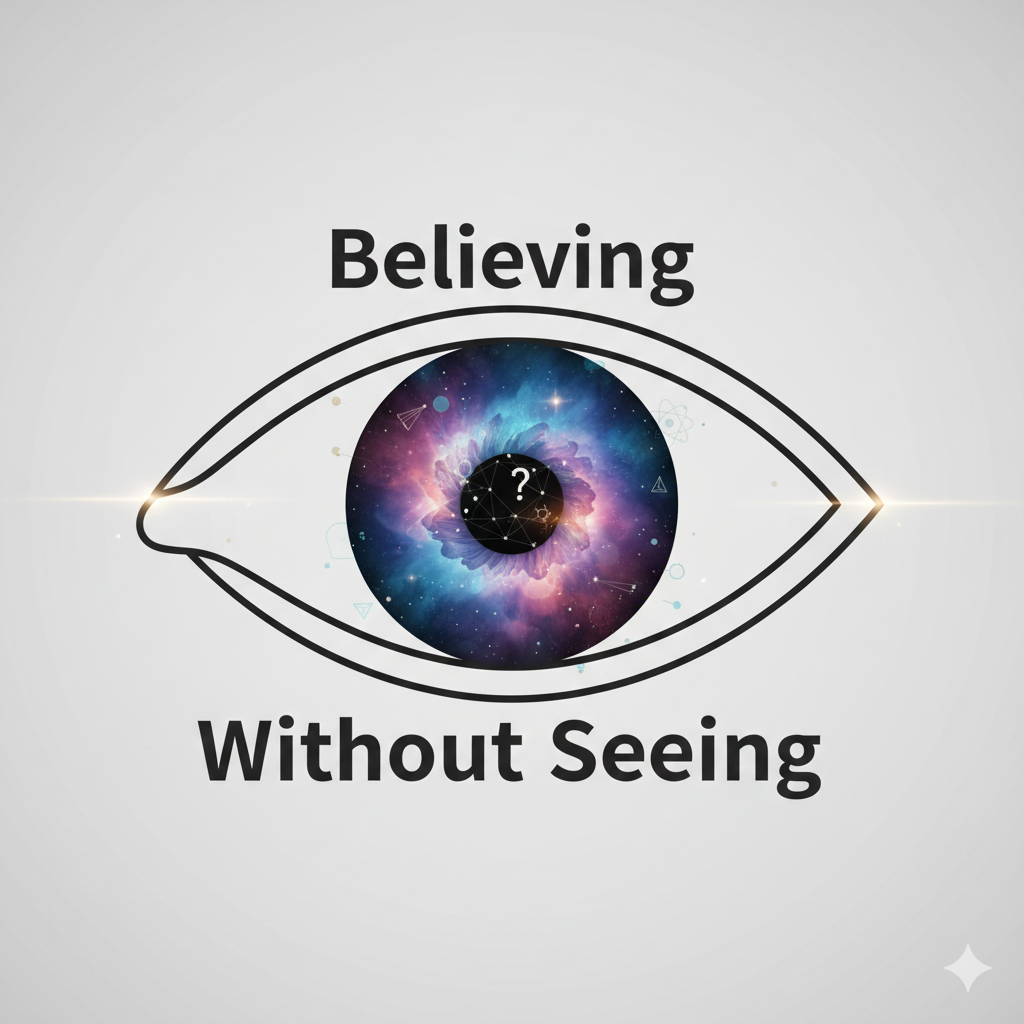
  • Believing Without Seeing

    Believing Without Seeing

    We rarely notice how much of what we believe rests on things we cannot directly see. Science asks us to accept entities, forces, and structures that appear only through their effects. Philosophy steps in at this point, not to question science, but to ask what makes such a belief reasonable in the first place.

    When Inference Justifies Belief

    We live surrounded by things we cannot directly experience. Atoms, black holes, gravity, even other minds. Our senses reveal only a thin slice of reality, yet we form beliefs about what lies beyond.

    So the real question is not whether we can see something. The question is when believing the unseen becomes reasonable.

    The whole of science is nothing more than a refinement of everyday thinking.

    Albert Einstein, Physics & Reality

    The limits of perception

    Human perception evolved for survival, not truth. We see objects at the human scale, but the microscopic, the cosmic, and the abstract remain hidden.

    Human perception is selective. It filters rather than reveals. What we experience is already interpreted by cognitive models that prioritise usefulness over completeness. Colour, solidity, and continuity are not properties we perceive directly at the fundamental level. They are stable interpretations that help us navigate the world.

    In this sense, the gap between appearance and reality is not unusual. It is the normal condition of knowing. Science does not introduce that gap. It makes it explicit and tries to bridge it.

    For example, a table appears solid, yet physics describes it as mostly empty space structured by forces. The difference is not an error in perception, but a difference in explanatory level.

    Science begins where perception fails.

    Human senses reveal the visible world, while science uncovers hidden layers of reality.

    We believe in many things we cannot see because they explain the world better than anything else.

    Indirect evidence works

    We never see electrons directly. Yet their existence explains chemical bonds, electricity, and modern technology.

    Experiments do not show electrons themselves. They show patterns that make electrons the best explanation. The double slit experiment is a powerful example. What we observe is behaviour, not the object itself.

    Much of scientific knowledge relies on instruments that extend perception. Microscopes, detectors, and sensors do not simply show hidden objects. They translate interactions into signals that must be interpreted. What scientists observe is rarely the entity itself, but the trace it leaves.

    This makes inference unavoidable. We move from effects to causes, from measurements to models. The strength of indirect evidence lies in repeatability. When different experiments produce compatible traces, confidence grows even without direct observation.

    This is why entities like electrons feel less speculative than they might appear. They participate in explanations across chemistry, physics, and engineering. Their reality is supported by how much of the world becomes intelligible once they are assumed.

    Indirect evidence is often stronger than direct perception.

    Electrons are inferred from experimental patterns rather than directly observed.

    Science often works by trusting indirect evidence, not direct observation.

    When theory becomes real

    Black holes began as mathematical objects in relativity. For decades, they were theoretical objects.

    Over time, different lines of evidence converged. Gravitational waves. Stellar motion. Telescope images. Theory moved into observation.

    This transition from theory to observation is rarely sudden. It is gradual and often messy. Early evidence reduces uncertainty rather than eliminating it, and competing interpretations may coexist for years, sometimes decades.

    A well-known example is the debate over the nature of light. For centuries, scientists disagreed about whether light was a wave or a particle. Different experiments supported different interpretations, and neither framework fully displaced the other. With the development of quantum mechanics, a new account emerged, showing that light behaves in ways that do not fit neatly into either category. Competing interpretations persisted because each explained part of the evidence.

    A similar pattern appears in cosmology. Observations revealed that galaxies are moving away from each other, yet scientists disagreed about why. Some explanations focused on the universe’s initial conditions, while others introduced new concepts such as dark energy. For years, multiple explanations coexisted as evidence accumulated and models were refined.

    What changes over time is not a single decisive moment, but the accumulation of constraints. As measurements improve, the space of plausible alternatives narrows. Eventually, the theoretical entity becomes the most stable explanation available.

    Black holes illustrate this process clearly. They were first mathematical possibilities, then astrophysical hypotheses, and finally observational targets. Each stage relied on inference before confirmation.

    Inference allowed belief long before confirmation arrived.

    Black holes show how inference can precede direct evidence.

    The invisible becomes real when evidence converges from different directions.

    The core idea — Inference to the best explanation

    Science does not accept ideas randomly. It compares explanations.

    When we observe patterns, there are usually multiple ways to explain them. Some explanations are narrow, some are complicated, and some fail when new evidence appears. Scientific reasoning works by weighing these possibilities rather than committing too quickly.

    An explanation becomes reasonable when it explains observations better than alternatives, generates predictions, fits with what we already know, and cannot be replaced by a simpler rival. The strength of an idea lies not in being imaginable, but in doing explanatory work.

    Philosophers call this process inference to the best explanation. We infer that something exists because it makes the world more understandable than competing accounts.

    Many central scientific ideas emerged this way. Gravity was accepted long before its mechanism was understood because it explained motion across the heavens and the earth with remarkable consistency. Today, dark matter occupies a similar position. It has not been directly observed, yet it explains patterns that otherwise remain puzzling.

    Inference does not guarantee truth. It provides the most reasonable belief available given current evidence. Science moves forward by trusting the explanation that works best, while remaining open to replacement when a better one appears.

    Scientific belief emerges when an explanation is selected that best fits the evidence.

    Inference is not guessing. It is disciplined explanation.

    The frontier — dark matter

    Galaxies rotate in ways that visible matter cannot explain. Something unseen appears to influence gravity.

    Dark matter is compelling because the same discrepancy appears in multiple contexts. Galaxy rotation curves, gravitational lensing, and large-scale structure all suggest the presence of more mass than we can see. The consistency of this pattern is what gives the idea weight.

    At the same time, dark matter remains a frontier because alternative explanations are still explored. Modified gravity theories attempt to explain the same observations without introducing new entities. This is exactly how science should operate. Competing explanations sharpen inference.

    The interesting philosophical point is that belief here is graded rather than binary. Scientists treat dark matter as the best current explanation while actively searching for ways it might be wrong.

    Dark matter has not been directly detected. Yet its effects are consistent across observations.

    Science often believes before it sees.

    Dark matter is inferred from gravitational effects rather than direct observation.

    Dark matter shows that science is comfortable believing before seeing.

    The boundary of reason

    Not every unseen claim deserves belief. Some ideas cannot be tested, predicted, or explained.

    An undetectable object that leaves no trace explains nothing. It does not compete with scientific explanations.

    Testability marks the boundary between inference and speculation.

    The distinction is not between visible and invisible. It is between explanatory and non-explanatory posits. An unseen entity becomes reasonable when removing it makes our understanding worse. If nothing changes when the entity is removed, the posit does no work.

    This is why unfalsifiable claims struggle within scientific reasoning. They cannot be constrained by evidence and therefore cannot improve explanations. Science does not reject them because they are invisible, but because they do not participate in the cycle of refinement.

    Testability, in this sense, is less about immediate experiments and more about vulnerability. Reasonable ideas risk being wrong.

    Reasonable beliefs require explanations that can be tested against evidence.

    Not every explanation deserves belief. Testability draws the boundary.

    The inference cycle

    Belief in science is not permanent. It is iterative.

    This iterative structure explains why scientific belief feels both stable and revisable. Stability comes from repeated success. Revision comes from the expectation that explanations are provisional.

    Importantly, the cycle operates at multiple timescales. Some explanations change quickly, others remain stable for centuries. What matters is not permanence but performance. An explanation earns trust by continuing to organise experience effectively.

    Inference, therefore, functions less like a single decision and more like an ongoing commitment. We act as if an explanation is true while remaining prepared to update it.

    Observation leads to patterns. Patterns lead to hypotheses. The best explanation generates predictions. New evidence either strengthens or replaces the belief.

    This cycle makes scientific belief dynamic rather than absolute.

    Scientific belief evolves through a continuous cycle of explanation and evidence.

    Scientific belief is provisional. It lasts until a better explanation appears.

    Resolution — why inference justifies belief

    We accept the unseen when evidence demands it. When patterns persist. When explanations predict. When knowledge becomes more coherent.

    Inference allows us to move beyond the limits of perception without abandoning reason.

    Belief in science is not about certainty. It is about the best explanation available right now.

    And that is enough to act, to build, and to understand the invisible world.

    Seen this way, inference is not a weakness of knowledge but its primary engine. Direct observation alone would leave most of reality inaccessible. Explanation allows us to extend understanding beyond immediate experience without abandoning discipline.

    The philosophical significance is broader than science. Every day reasoning follows the same pattern. We infer intentions from behaviour, causes from outcomes, and structures from patterns. Scientific inference is a refined version of a familiar cognitive move.

    The same structure appears outside science. Religious belief, too, often operates through inference, drawing conclusions from experience, coherence, and explanatory scope rather than direct observation. Traditions can be understood as competing interpretations of shared human phenomena, each attempting to make sense of consciousness, value, suffering, and order. Whether these inferences should be evaluated like scientific ones or according to different standards is a question that opens the next stage of this conversation.

    Knowledge advances when we follow patterns, trust explanations, and remain open to better evidence.