
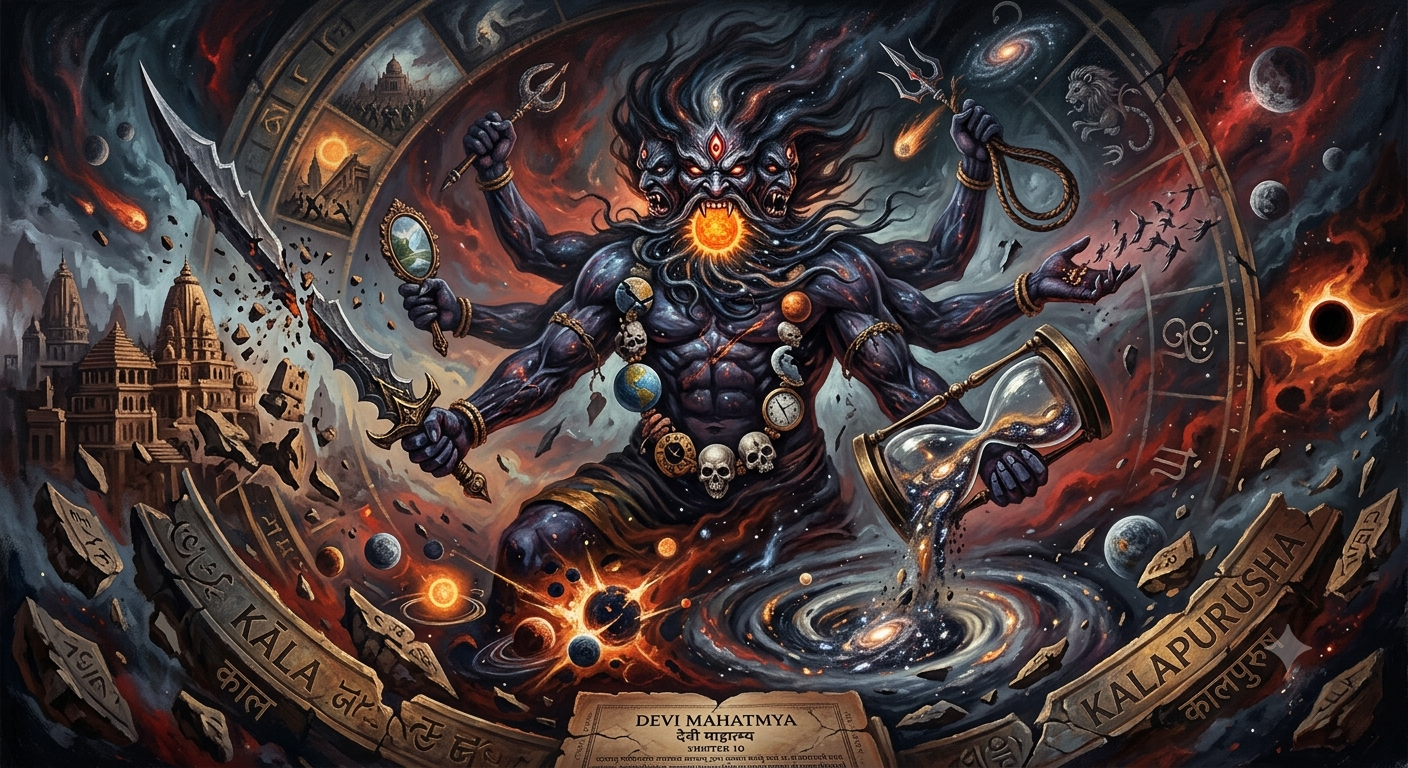
Introduction: Is Time Just a Background?
What if time is not a neutral container in which events unfold, but an active force that shapes and dissolves reality? This question lies at the heart of one of the most powerful philosophical ideas in the Bhagavad Gītā.
In modern science, time is often treated as a parameter or dimension. But in Hindu thought, particularly in the concept of kāla, time carries a deeper meaning—one that connects it to change, destruction, and even the divine itself.
The Meaning of Kāla in Sanskrit
The Sanskrit word kāla is commonly translated as “time,” but this translation is incomplete.
Kāla also implies:
- Change and transformation
- Decay and destruction
- Fate or destiny
- The inevitable passage of existence
This broader meaning suggests that time is not passive. It is not something we simply measure with clocks, it is something that actively participates in the unfolding of reality.
“I Am Time”: Bhagavad Gītā 11.32
A defining moment in the Bhagavad Gītā occurs in Chapter 11, Verse 32, when Kṛṣṇa reveals his universal form (Viśvarūpa) and declares:
“कालोऽस्मि लोकक्षयकृत्प्रवृद्धो
लोकान्समाहर्तुमिह प्रवृत्तः ।
ऋतेऽपि त्वां न भविष्यन्ति सर्वे
येऽवस्थिताः प्रत्यनीकेषु योधाः ॥”
A clear translation reads:
“I am Time, the mighty destroyer of worlds, engaged in annihilating these beings.”
This statement radically shifts the way time is understood. Time is no longer a background dimension—it is an active, cosmic force identified with the divine itself.
Time as a Cosmic Force in Hindu Philosophy
Across Hindu texts, kāla appears as a fundamental principle governing existence. It is deeply connected with:
- Creation (sṛṣṭi)
- Preservation (sthiti)
- Dissolution (pralaya)
Everything that arises is already subject to time. Growth, aging, decay, and death are not accidental processes, they are expressions of kāla.
This makes time inseparable from change itself. Without time, there would be no transformation, no becoming, only static being.
Is Time the Same as Change?
This raises an important philosophical insight: perhaps time is not what clocks measure, but what makes change possible.
In this view:
- Motion does not define time; it reveals it
- Physical measurements track processes, not time itself
- Time may be understood as a condition for transformation
This perspective aligns intriguingly with philosophical interpretations of time, though it differs significantly from scientific definitions.
Kāla and Modern Physics: A Careful Comparison
It is tempting to compare kāla with modern scientific concepts such as entropy or the arrow of time. Both involve directionality and irreversible change.
However, this comparison must be handled carefully:
- Entropy is a statistical and physical concept
- Kāla is metaphysical and theological
- Physics describes behavior; kāla expresses existential structure
While the resemblance is suggestive, they operate at fundamentally different levels of understanding.
Why This Idea Still Matters
The Gītā’s vision of time challenges a deeply ingrained assumption: that time is empty and neutral. Instead, it presents time as:
- Active rather than passive
- Transformative rather than static
- Integral to existence rather than external to it
To say “Kṛṣṇa is time” is to assert that the processes of creation and destruction are not separate from ultimate reality, they are expressions of it.
Conclusion: Time Beyond Measurement
The concept of kāla invites us to rethink time not as a simple coordinate, but as a profound force embedded in the structure of existence.
It is not merely something we observe. It is something that acts.
In the Bhagavad Gītā, time is not just real, it is powerful, cosmic, and, in its deepest sense, divine.