

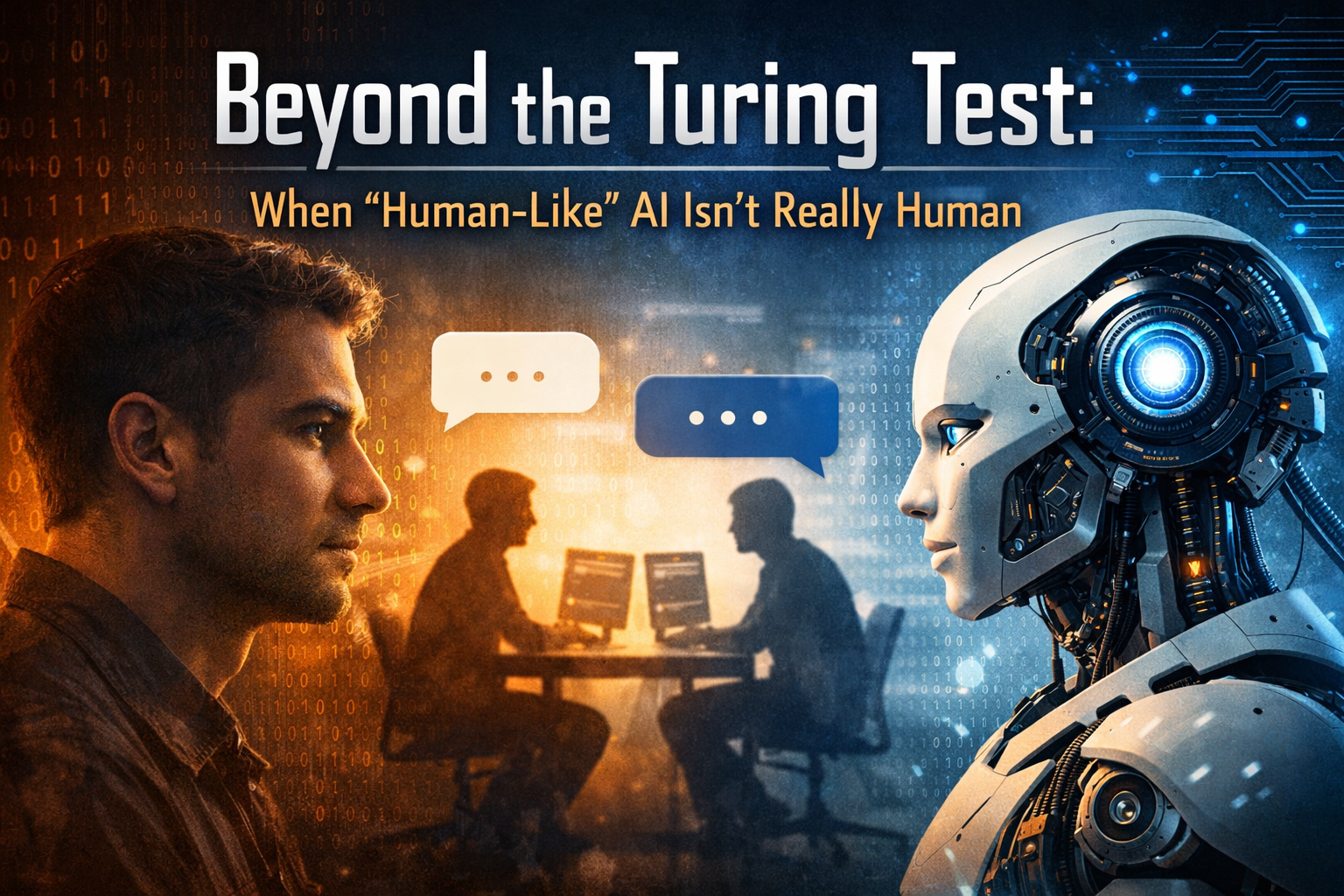
Every few years, a new wave of artificial intelligence captures public attention. Chatbots start sounding more natural. Machines write poems, code, and essays. Some even offer emotional support. And inevitably, the same question resurfaces:
“Has AI finally become intelligent?”
Often, this question is framed in terms of a famous benchmark proposed more than seventy years ago, the Turing Test. If a machine can talk like a human, does that mean it thinks like one?
As someone who works closely with technology, I’ve found that the answer is far more complicated than it first appears.
From Philosophy to Observable Behavior
In 1950, British mathematician and computer scientist Alan Turing published a groundbreaking paper titled “Computing Machinery and Intelligence.” In it, he proposed what later became known as the Turing Test.
Rather than arguing about abstract definitions of “thinking,” Turing suggested a simple experiment:
A human judge communicates through text with two unseen participants—one human and one machine. If the judge cannot reliably tell which is which, the machine is said to have passed the test.
Turing’s idea was revolutionary for its time. It shifted the conversation from philosophy to observable behavior. Intelligence, he suggested, could be judged by how convincingly a machine behaved in human conversation.
Why Passing the Test Feels So Impressive
When an AI passes something like the Turing Test, it demonstrates several remarkable abilities:
- It can use natural language fluently
- It responds appropriately to context
- It adapts to tone and emotion
- It maintains long, coherent conversations
To most people, this feels like intelligence. After all, language is one of our strongest markers of human cognition. If something talks like us, we instinctively assume it thinks like us.
Modern language models amplify this effect. They can discuss philosophy, explain technical concepts, and even joke convincingly. In short interactions, they often feel “alive.”
But appearance is not reality.
But Imitation is Not Reality
One of the strongest critiques of the Turing Test comes from philosopher John Searle. In his famous “Chinese Room” thought experiment, Searle imagined a person who manipulates Chinese symbols using a rulebook, without understanding Chinese.
From the outside, the system appears fluent. Inside, there is no comprehension.
Searle’s argument was later developed in his book Minds, Brains, and Programs.
The parallel with modern AI is clear:
A system can produce correct, fluent answers without grasping their meaning.
It processes patterns, not concepts.
There are several other limitations in the Turing Test.. The Turing Test is essentially an “imitation game” that rewards the best liar. By focusing purely on conversation, it ignores the “big picture” of intelligence—like moral reasoning and creativity—while leaving the final verdict up to the mercy of biased human judges. In fields like healthcare or finance, we need transparency, not a machine that’s just good at pretending.
To move beyond the limitations of mere imitation, the industry has developed more rigorous, multi-dimensional benchmarks. This is a shift that defines how AI is evaluated today.
Modern Benchmarks for Machine Intelligence
As AI research matured, scientists moved beyond the Turing Test. Today, intelligence is evaluated across multiple dimensions.
Reasoning Benchmarks
Projects like BIG-bench and the ARC Challenge test logical reasoning, abstraction, and problem-solving.
General Knowledge and Transfer
The Massachusetts Institute of Technology and other institutions study whether AI can generalize knowledge across domains, a core feature of human learning.
Embodied Intelligence
Some labs, including OpenAI, explore how AI behaves in simulated environments, learning through interaction rather than text alone.
Safety and Alignment
Modern evaluations increasingly focus on whether systems behave responsibly and align with human values, not just whether they sound smart.
These approaches reflect a more mature understanding of intelligence.
Why Passing the Turing Test Does Not Mean “Thinking”
Even if an AI consistently fools human judges, it still does not think like a human in any meaningful sense.
1. Patterns vs. Mental Models
AI systems learn by analyzing enormous datasets and predicting likely sequences. They recognize correlations, not causes.
Humans build mental models of the world grounded in experience.
2. No Conscious Awareness
There is no evidence that current AI systems possess subjective awareness. They do not experience curiosity, doubt, or reflection.
Philosopher David Chalmers famously described consciousness as the “hard problem” of science. AI has not come close to solving it.
3. No Intentions or Desires
Humans think in terms of goals, fears, hopes, and values. AI has none of these internally. Any “motivation” is externally programmed.
4. No Moral Responsibility
We hold humans accountable for their actions. We cannot meaningfully do the same for machines. Responsibility always traces back to designers and operators.
The Illusion of Intelligence
While researching for this blog post, I found several references to a book, Artificial Intelligence: A Modern Approach by Stuart Russell and Perter Norvig. The authors note in this book that much of AI’s success comes from exploiting narrow problem structures.
When AI speaks fluently, we instinctively anthropomorphize it. We project personality, intention, and emotion onto it. I think this is a psychological reflex and we confuse convincing behavior with inner life.
Rethinking What Intelligence Really Means
The Turing Test remains historically important. It sparked decades of innovation and philosophical debate. But in today’s context, it feels outdated.
Instead of asking:
“Can machines fool us?”
We should ask:
- Can they reason reliably?
- Can they support human decision-making?
- Can they reduce harm?
- Can they enhance creativity and productivity?
These questions matter far more than imitation.
As AI researcher Yann LeCun has often emphasized, intelligence is not just about language, it is about learning, planning, and interacting with the world.
Intelligence Without Illusion
Passing the Turing Test is an impressive technical milestone. It shows how far machine learning and language modeling have progressed.
But it does not mean machines think, understand, or experience the world as humans do.
Today’s AI systems are powerful tools, statistical engines trained on vast amounts of human-generated data. They extend our capabilities, automate tasks, and sometimes surprise us.
They do not possess minds.
The real challenge of AI is not to build perfect human imitators, but to create systems that responsibly complement human intelligence, while respecting the depth, complexity, and fragility of our own.
In the long run, that goal is far more valuable than passing any imitation game.